
Guides
States With Age Verification Laws: All 27, With Dates (2026)
Which US states require adult sites to check your age, when each law took effect, who enforces it and what it changes on a live cam site. Checked November 3, 2026.

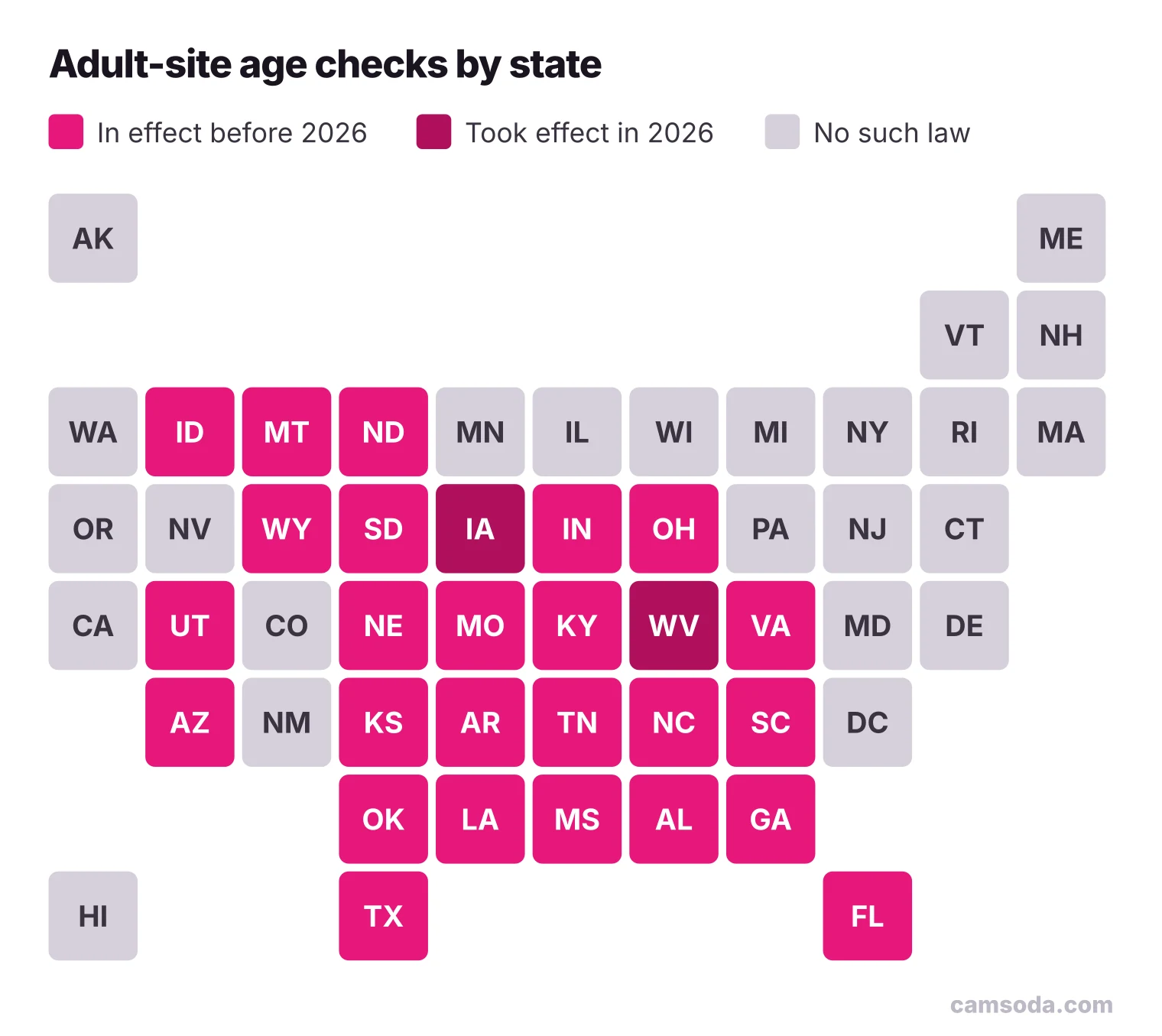
As of November 3, 2026, there are 27 states with age verification laws for adult websites: Alabama, Arizona, Arkansas, Florida, Georgia, Idaho, Indiana, Iowa, Kansas, Kentucky, Louisiana, Mississippi, Missouri, Montana, Nebraska, North Carolina, North Dakota, Ohio, Oklahoma, South Carolina, South Dakota, Tennessee, Texas, Utah, Virginia, West Virginia and Wyoming. These laws require sites with a large share of adult content to confirm that visitors are 18 or older, usually with an ID, a digital ID or a verification service. The Supreme Court upheld this kind of law in 2025.
This page lists every state, with its law and the date it took effect, explains what the laws require and who enforces them, and what they change when you visit a live cam site. Every status here was checked on November 3, 2026, and these laws change often. This is general information, not legal advice: for a question about your own situation, ask a lawyer licensed in your state.
States with age verification laws: the full list
The table below lists the 27 states with an age verification law for adult websites in effect on November 3, 2026. It combines the Free Speech Coalition’s state tracker, which gives effective dates, and the Age Verification Providers Association’s state overview, which gives bill numbers and details and describes the position as of September 2026. Where the two differ, the note says so.
| State | Law | Took effect | Note |
|---|---|---|---|
| Alabama | HB 164 | Oct 1, 2024 | Also requires a health warning on covered sites |
| Arizona | HB 2112 | Sept 26, 2025 | Private right of action |
| Arkansas | SB 66 | July 31, 2023 | |
| Florida | HB 3 | Jan 1, 2025 | Sites must offer at least one anonymized verification option |
| Georgia | SB 351 | July 1, 2025 | The same law also covers social media; AVPA files it as a social media law, the FSC lists it |
| Idaho | H 498 | July 1, 2024 | |
| Indiana | SB 17 | July 1 / Aug 16, 2024 | The FSC lists both dates |
| Iowa | HF 864 | July 1, 2026 | Newest law on the list, with West Virginia |
| Kansas | SB 394 | July 1, 2024 | Applies when 25% or more of pages viewed in a month are covered material |
| Kentucky | HB 278 | July 15, 2024 | |
| Louisiana | Act 440 (HB 142), then HB 77 | Jan 1, 2023 | The first state; HB 77 added attorney general enforcement in August 2023 |
| Mississippi | SB 2346 | July 1, 2023 | |
| Missouri | Attorney general rule, then HB 1839 | Nov 30, 2025 | Started as a regulation; a 2026 statute wrote it into law |
| Montana | SB 544 | Jan 1, 2024 | |
| Nebraska | LB 1092 | July 18, 2024 | |
| North Carolina | HB 8 | Jan 1, 2024 | |
| North Dakota | HB 1561 | Aug 1, 2025 | A second law, SB 2380, adds device and app-store age signals from Aug 1, 2026 |
| Ohio | HB 96 | Sept 30, 2025 | Adds geofencing and periodic re-verification |
| Oklahoma | SB 1959 | Nov 1, 2024 | |
| South Carolina | HB 3424 | Jan 1, 2025 | |
| South Dakota | HB 1053 | July 1, 2025 | |
| Tennessee | SB 1792 | Jan 2025 | Breaking the rules is a Class C felony; the start date moved after a court ruling |
| Texas | HB 1181 | Sept 2023 | Upheld by the Supreme Court in 2025 |
| Utah | SB 287 | May 3, 2023 | Updated by SB 73 in 2026 |
| Virginia | SB 1515 | July 1, 2023 | |
| West Virginia | HB 4412 | June 12, 2026 | |
| Wyoming | HB 43 | July 1, 2025 | Private right of action |
If you came here wondering why a site asked for your age, our guide on whether cam sites are legal covers the wider legal picture: the 18+ rule, federal record-keeping and what the law asks of viewers. For how the sites themselves differ, start with our overview of cam sites and how to choose one.
States without an adult-site age verification law
On November 3, 2026, neither tracker lists an adult-site age verification law in force in these 23 states and Washington, DC: Alaska, California, Colorado, Connecticut, Delaware, Hawaii, Illinois, Maine, Maryland, Massachusetts, Michigan, Minnesota, Nevada, New Hampshire, New Jersey, New Mexico, New York, Oregon, Pennsylvania, Rhode Island, Vermont, Washington and Wisconsin.
No law does not mean no check. A site can still ask your age everywhere, through its own terms or because of laws in other countries it serves. And several of these states have bills in progress, listed below.
How the laws spread, year by year
Louisiana went first, with a law in effect on January 1, 2023. Other states copied its model: by the end of 2023 six states had a law in force, and the count grew to 15 in 2024 and 25 in 2025. Iowa and West Virginia brought it to 27 in 2026.
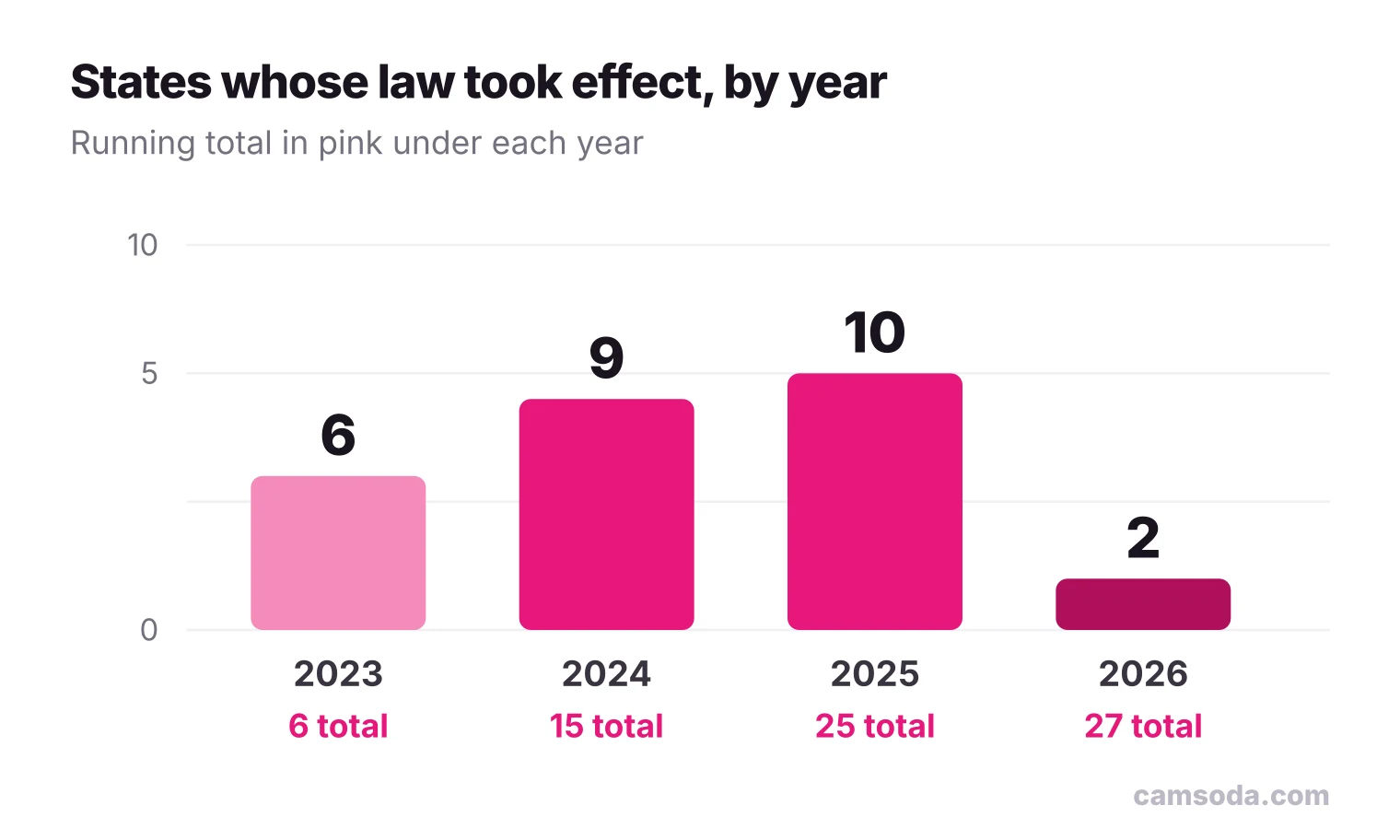
The pace slowed in 2026 for a simple reason: most states that wanted such a law already had one, and many of the states without one have not moved bills forward.
What these laws require
The state laws share a template, with local changes. In most of them:
- Who is covered: a commercial website where more than one-third of the content is sexual material harmful to minors. Some states use other tests: Kansas counts 25% of the pages viewed in a month, Tennessee and West Virginia say a “substantial portion”, Kentucky and Ohio cover sites that publish such material without a fixed share.
- What the site must do: check that each visitor from the state is 18 or older before showing covered content.
- How it can check: a government-issued ID, a state digital ID, a commercial system that checks transactional data such as mortgage or other records, or a third-party verification service. Florida requires sites to offer at least one anonymized option. Some newer laws, such as Ohio’s, add location checks and re-verification at intervals.
- What happens to your data: many laws forbid keeping identifying information after the check. Louisiana’s does, Missouri bars the third-party verifier from retaining it, and Ohio, Tennessee and West Virginia set data deletion or retention limits.
A simple “I am 18” button does not meet these laws. The laws regulate sites, not visitors: the duties and penalties fall on the companies that run covered websites.
The Supreme Court ruling: Free Speech Coalition v. Paxton
Adult industry groups challenged Texas HB 1181, arguing it burdened adults’ free speech. On June 27, 2025, in Free Speech Coalition v. Paxton, the Supreme Court upheld the law 6 to 3. Justice Thomas wrote for the Court; Justice Kagan wrote the dissent, joined by Justices Sotomayor and Jackson.
The Court held that the law triggers intermediate scrutiny, not the strictest test, and passes it. Its reasoning in short: states may keep minors from sexual content that is obscene for them, requiring proof of age is an ordinary way to do that, and adults have a right to access the content but “no First Amendment right to avoid age verification.” The Court also called government ID and transactional data “plainly legitimate” methods. The ruling settled the constitutional question for laws built like Texas’s, and most of the state laws in the table follow the same template.
Who enforces these laws
The laws differ most on who can go after a site that does not comply. According to the AVPA overview (September 2026), they fall into three groups:
| Enforcement model | Examples | What it means |
|---|---|---|
| Private lawsuits | Louisiana, Utah, Mississippi, Virginia, Arkansas, Texas (HB 1181), Montana, North Carolina, Kentucky, Wyoming, North Dakota, Arizona | A parent or other person harmed can sue the site for damages |
| Attorney general action | Louisiana (HB 77), Ohio, Missouri, West Virginia | The state sues for civil penalties; in Louisiana, $5,000 a day, or $10,000 if knowing, after a 30-day notice |
| Criminal penalty | Tennessee | Violating the verification or data-retention rules is a Class C felony |
Enforcement targets the companies that run sites. That is why a site’s response is a business decision: verify visitors from the state, or block the state entirely. Several large adult sites chose to block states rather than verify.
What this means on a live cam site
None of the state trackers says a word about live cam sites, but the laws do not care whether content is recorded or live. A cam site that meets a state’s content test has the same duty as any other adult site: check that visitors from that state are adults before they see covered content, or not serve the state.
For you as a viewer, that means:
- What you see depends on where you are. In a state with a law, a site may ask you to verify your age before showing adult rooms. In a state without one, it may only ask you to confirm you are 18. Two viewers on the same site can see different steps.
- The method varies. Depending on the law and the site, you may be asked for an ID, a digital ID or a check by a third-party verification service.
- A check is a sign of compliance. Being asked for proof of age means the site is following the law where you are, not that something is wrong with your account.
CamSoda, whose blog this is, says in its Help Center that age verification is required to access 18+ content in locations where the law requires it, and its terms require users to be 18 or the age of majority where they live, whichever is higher. The flow is not the same for every viewer everywhere: it depends on the rules where you are.
Privacy: what happens to your ID
The strongest criticism of these laws is about data. The EFF and other critics point out that uploading an ID to a website or a third-party verifier creates a record that can be breached, and that people without a current ID can be shut out. The laws answer part of this with retention limits: as listed above, many forbid the site or the verifier from keeping identifying information after the check.
Before you verify, read the privacy policy of the site you use and see what it says about identity documents. CamSoda’s privacy policy, for example, says it may collect a government-issued photo ID and describes keeping identification for legal compliance, including age verification. Our guide on whether cam sites are safe covers the rest: payment privacy, scams and what to share in chat.
Why the counts differ from one source to the next
Search this topic and you will find 24, 25 or 27 states. The pages ranking for it disagree, and some are out of date. A state list from World Population Review says its data is accurate as of May 2025, so it misses later laws. A state-by-state list from a counseling provider marks Alabama and Ohio as having no law, although both trackers list Alabama’s law in effect since October 2024 and Ohio’s since September 2025. An Iowa news report in June 2026 said the state “joins 25 states”, while both trackers count 27 with Iowa.
The differences come from four choices:
- Signed or in effect. Some lists count a law when the governor signs it, others when it takes effect, often months later.
- Statute or regulation. Missouri started with an attorney general rule before it had a statute, so some lists skipped it until 2026.
- Mixed laws. Georgia’s SB 351 covers adult sites and social media in one bill, so lists file it differently.
- Court rulings. Some start dates moved because of injunctions and appeals, as in Texas and Tennessee.
To check one state yourself: find the bill on the state legislature’s website and read its effective date, look it up in a tracker that shows dates (the two linked above), and search recent news for a court ruling on it.
Bills still pending
The AVPA overview (September 2026) lists bills under consideration but not law, among them New Jersey S1826, S4455 and A3228, Pennsylvania SB 603, and a second Ohio bill, HB 84, which passed the Ohio House. It describes bills in Illinois and Minnesota as stalled and notes no 2026 progress for Hawaii’s. Any of these could change the map, so check the date on any list you rely on, including this one.
Not the same law: social media and app stores
Many searches mix up two kinds of age verification law. The laws on this page apply to adult websites. A second wave targets social media and app stores: it asks platforms to verify the age of young users, or app stores and phone makers to pass on an age signal, and often requires parental consent for minors. Several of those laws have been blocked or challenged in court, and they follow different rules from the adult-site laws in the table above. If a list of “age verification states” includes California or New York, it is usually counting this second kind.
When you are ready to watch, public rooms on CamSoda are free for adults, and our list of free adult cam sites compares what you get without paying.
Frequently asked questions
What states don’t have age verification laws?
As of November 3, 2026, 23 states and Washington, DC have no adult-site age verification law in force: Alaska, California, Colorado, Connecticut, Delaware, Hawaii, Illinois, Maine, Maryland, Massachusetts, Michigan, Minnesota, Nevada, New Hampshire, New Jersey, New Mexico, New York, Oregon, Pennsylvania, Rhode Island, Vermont, Washington and Wisconsin. Sites may still ask for your age there under their own rules.
Does New York have an age verification law for adult sites?
No. As of November 3, 2026, neither the Free Speech Coalition nor the AVPA tracker lists an adult-site age verification law in New York. Laws about minors on social media and apps are a separate category.
Does New Jersey have an age verification law?
Not for adult sites, as of November 3, 2026. The AVPA overview lists New Jersey bills S1826, S4455 and A3228 as pending in September 2026, so check the legislature’s site for their current status.
Is porn banned in any US state?
No. No state bans legal adult content for adults, and the Supreme Court said in its 2025 ruling that states may keep it from minors but may not keep it from adults. What 27 states do is require sites to check that visitors are 18 or older, and some sites choose to block those states instead.
Is there a federal age verification law?
Not for adult websites, as of November 3, 2026. The age checks US viewers meet on adult sites come from state laws, and the Supreme Court upheld Texas’s version in Free Speech Coalition v. Paxton in June 2025.
Do cam sites have to verify your age?
In states with these laws, a cam site whose content meets the state’s test must check that visitors are 18 or older, or block the state. Elsewhere, sites usually ask you to confirm your age, and the steps differ by location. Performers always prove their age with a government ID on legitimate cam sites.