Guides
Are Cam Sites Safe? How Cam Site Scams Work and How to Avoid Them
Established cam sites are safe for adults who keep chats and payments on the platform. Here is how cam site scams work, how to check a site is legit and what to do if something goes wrong.

Are cam sites safe? Yes, established cam sites are generally safe for adults to use, as long as you keep chatting, paying and watching on the platform itself. Most cam site scams start when someone moves you off the site: to a messaging app, a direct payment or a link. The real risks are sextortion, payments outside the site’s checkout, lookalike sites and oversharing personal details, and each one has a simple defense.
This guide covers how cam site scams work, a checklist to tell a legit site from a fake one before you pay, how billing works on a real platform, what privacy a site can and cannot give you, and what to do if something already went wrong.
Are cam sites safe? Legit sites vs cam site scams
The question mixes two different things. A legitimate cam site is a business with published terms, a privacy policy, a minimum age, a help center and a checkout run by payment processors. A scam is a person or a fake site that uses the idea of a cam show to get your money, your card number or compromising video of you. If you want the broader picture of how the main platforms compare, start with our overview of cam sites.
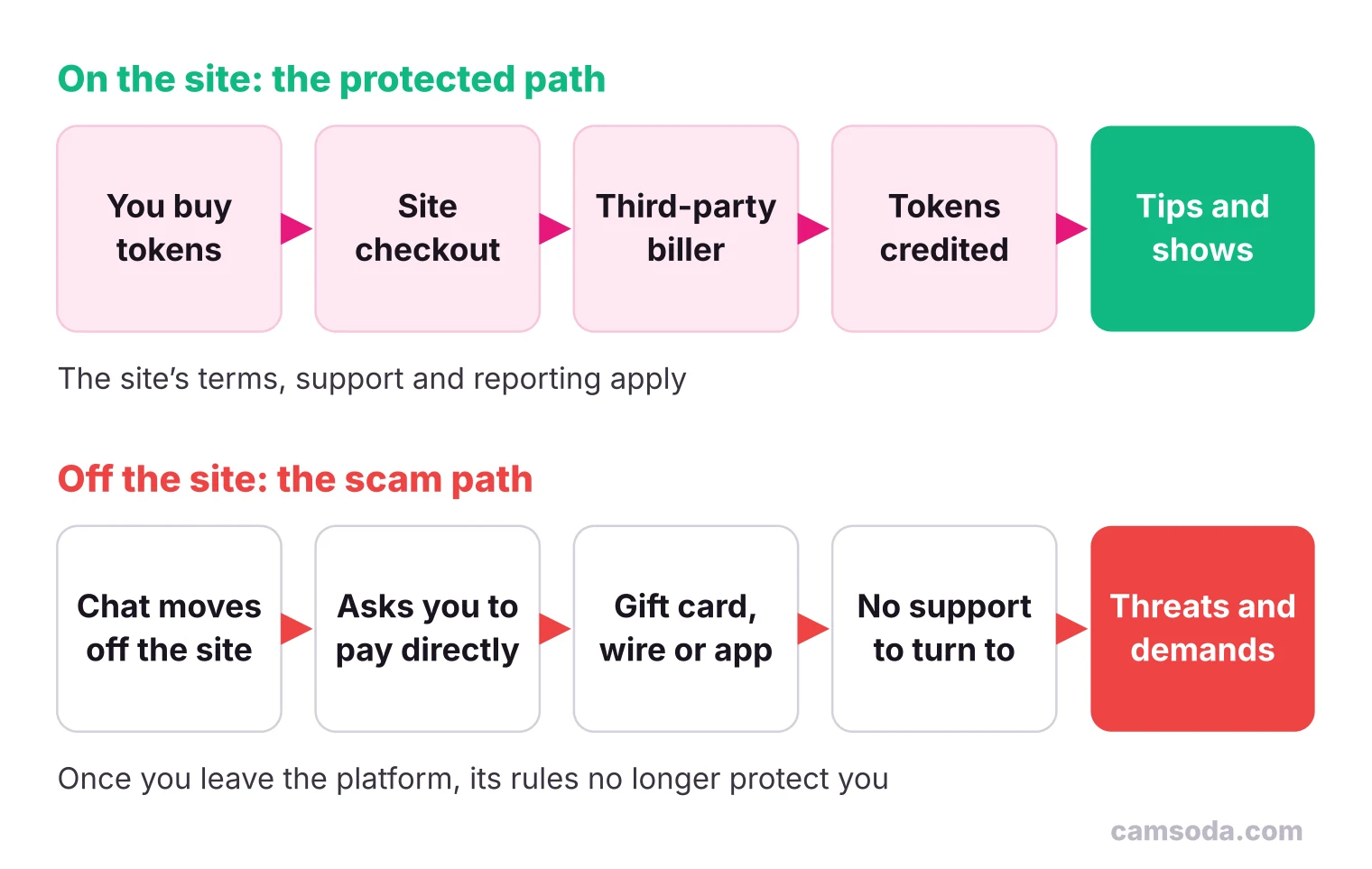
On a real platform, the main safety rule is simple: everything that involves money or personal contact stays inside the site. The site’s rules, support and reporting tools only cover what happens on the site. Once a conversation or a payment leaves it, nobody stands between you and the other person.
One note on wording: searches for “live cam safety” sometimes mean scenic webcams, like city or wildlife streams. Those are public video feeds of places and carry ordinary web risks. This guide is about adult cam sites, where adults 18+ watch and interact with live performers.
The real risks, and how each one starts
| Risk | How it usually starts | Your defense |
|---|---|---|
| Sextortion | Someone gets you on video, often after moving the chat to another app, then threatens to share it | Keep shows on the site, keep your face and identifying details out of frame on cam2cam, never send intimate images to a stranger |
| Direct-payment fraud | A “performer” asks for money, gift card codes or your card number outside the site’s checkout | Pay only through the site’s token checkout |
| Fake or lookalike sites | A link from a pop-up, an ad or a message leads to a site with no terms, no billers and a payment form | Type the address yourself and run the checklist below |
| Malware and phishing links | “Click here for my private page” or a download offered in chat | Don’t open links or files from people you meet in chat |
| Surprise charges | A private show that runs longer than planned, or an auto-refill setting you forgot about | Check the per-minute rate before you start and review refill settings |
| Oversharing | Your real name, city or a photo used elsewhere ends up in a profile or chat | Use a username and an email you don’t use anywhere else |
Cam site scams: how they work
The scams have a common shape. The FBI’s Internet Crime Complaint Center describes sextortion as someone threatening to distribute your private material unless you meet their demands, and notes that victims often meet the scammer on one site or app and are then moved to another messaging platform. In that IC3 warning on sextortion, the FBI said it had received over 16,000 sextortion complaints in 2021 by July 31, with losses above $8 million, and that nearly half of the victims were 20 to 39 years old. Adults are the main target, not a rare exception.
The off-site move
The most common pattern: a profile, often on a dating app or social network, says she or he is a cam model and suggests moving to WhatsApp, Skype, Telegram or a private video call “to get to know each other.” The video can be prerecorded. Once you are on camera in a compromising moment, the threats start: pay, or the recording goes to your contacts. A real performer on a real site has no reason to take a paying viewer off the platform, where they would lose the site’s billing and its protection too.
“Pay me directly”
Some scams skip the video. The person asks you to send money through a payment app, a wire, crypto to a personal wallet or gift card codes, for “special content,” rent, a sick relative or a trip to meet you. Legit sites sell tokens through their own checkout and you spend those tokens on the site. A request to pay a person directly, by any method, is the clearest red flag there is.
Fake profiles and prerecorded loops
Watch for a room where the chat and the video don’t match: the person never reacts to what is typed, never says your username, or the same few moves repeat. Stolen photos are common on dating and social profiles; a reverse image search of a profile picture often finds the real source.
Links, downloads and lookalike sites
“My private site,” “my free show link” or a file offered in chat can lead to malware or to a payment page built to steal card numbers. For the broader topic of viruses and risky adult sites, our guide to safe adult websites goes into detail.
“Free tokens” and “token generators”
Sites and videos that promise free tokens for any platform, in exchange for a login, a survey or a download, are scams aimed at your account or your device. Tokens come from the site you are on. If a site runs a promotion, it shows up on that site, not on a third-party page asking for your password.
Are cam sites legit? A checklist before you pay
You can check most of this in five minutes, before you buy a single token. A legitimate cam site publishes all of it; a scam site usually has none of it, or has pages that go nowhere.
| Look for | Why it matters |
|---|---|
| Terms and conditions with a stated minimum age | A real business sets rules for users and performers, including that everyone is an adult |
| A privacy policy with a “last updated” date | It tells you what data is collected and who handles your payment details |
| Named third-party billers | Card payments run through known payment processors, not a bare form on an unknown page |
| An 18 U.S.C. §2257 or record-keeping statement | US adult sites publish where age records are kept or why they are exempt |
| Prices shown before you pay | Token packages and private-show rates should be visible before you commit |
| A help center and a way to report users | You need somewhere to go if a charge or a person is wrong |
| Age verification where the law requires it | A site that follows local age rules is also following the other rules |
As a worked example, here is where CamSoda publishes each item. Its terms and conditions require users to be at least 18 or the age of majority where they live, whichever is higher, and prohibit any content or conduct involving minors. Its privacy policy was last updated April 16, 2026. Its biller options page names Epoch, PayPal, CCBill, Rocketgate, Segpay and Paygarden. Its §2257 statement is published too (dated 2015-05-16 on the page itself). Run the same check on any site you are considering. If your question is about this site in particular, see is CamSoda legit.
One limit worth knowing: a site having all of these pages tells you it is a real business, not that every person on it is honest. Most platforms, including the one above, say users are responsible for their own messages and that they act on reports rather than watch every room. The habits in the next sections still matter.
How paying works on a legitimate cam site
On a real platform you never pay a performer directly. You buy tokens from the site, the payment goes through a third-party processor, and the tokens land in your account. You then spend them on tips, interactive features or private shows, all inside the site. If you want the full mechanics of tokens, tips and show types, our guide to how cam sites work walks through them.
Three billing details prevent most surprise charges:
- Who holds your card details. The privacy policy in the example above says payment information is submitted to third-party payment processors and the site receives certain transaction information, including a partial hashed copy of it. Look for similar wording on any site.
- How private shows bill. On sites that bill by the minute, the rate is set by the performer and shown before you start. On the platform above, a minimum duration can be charged upfront, tokens are then deducted every 10 seconds, and unused minimum time is refunded only if the model ends the show early, per its private shows help page. Read the rate and the minimum before you click.
- Refill and credit settings. Some sites offer automatic token top-ups or a spend-now, pay-later credit line. These are opt-in conveniences, but they are also how people end up with charges they don’t remember. Check your account settings after you sign up.
A credit card generally gives you a dispute process through your card issuer if a charge is fraudulent, which is why some lawyers who handle these cases suggest a credit card over a debit card. Ask your issuer how its process works. Don’t assume a particular name will appear on your bank statement: no site’s billing descriptor should be taken for granted, so check your own statement after the first purchase. Price comparisons between platforms are in our guide to the cheapest cam sites.
Protect your privacy on any cam site
A cam site can protect its payment system and its accounts. It cannot stop another person from recording what is on their own screen, and it does not promise you full anonymity. The privacy policy from the example above, like most, says the site may collect account details, device and IP data, purchase information and, where verification applies, a government ID, and it warns that what you share in chats and on your profile may be visible to other users. Plan with that in mind.
- Username, not your name. Pick one that has nothing to do with your real name, city, job or other accounts.
- A separate email. Use an address you don’t use for work, banking or social media.
- A unique password and two-factor login where the site offers it. A reused password is how one breach turns into many.
- No profile photo of your face, and nothing you have posted elsewhere. Reverse image search links photos to other profiles in seconds.
- Cam2cam with care. If you turn your camera on, keep your face, tattoos, mail, windows and anything else identifying out of frame, and assume the other side can record. Turn the camera off or cover it when you are done.
- A VPN, for what it is. It hides your IP address from the site and your network from snooping. It does not make a scammer honest, stop recordings or protect texts and calls on your phone number.
- Don’t meet people from cam sites in person. If you ever decide to, meet in a public place and tell a friend where you will be.
- Keep your device updated and use any current, updated browser. Old software, not the browser brand, is what makes a device easy to attack.
If something already went wrong
If someone is threatening you with a recording, or you sent money you shouldn’t have, act in this order:
- Stop replying and don’t pay. Paying marks you as someone who pays, and the demands often continue. The FBI’s advice is to stop all interaction with the extortionist.
- Save the evidence. Screenshot the messages, usernames, profile links, phone numbers, emails and payment details before you block anyone. Don’t delete the conversation.
- Report the account to the cam site, dating app or social network where it started, so it can be shut down.
- Call your bank or card issuer if you paid, and ask about disputing the charge.
- File a report with the FBI at ic3.gov if you are in the US, or with your national police or cybercrime agency elsewhere.
- Protect your images. If you were 18 or older in an intimate image that is being threatened, StopNCII.org is a free tool that creates a digital fingerprint (a hash) of the image on your own device, without uploading it, so participating platforms can detect and block it.
Be careful with paid “recovery” help. In a separate IC3 warning about for-profit companies, the FBI said some firms use threats, manipulation and false information to get sextortion victims to pay, and may discourage them from going to the police. The FBI suggests contacting law enforcement and non-profit groups that help at no cost, and being wary of anyone who contacts you first, wants payment upfront or uses pressure.
If you are asking as a model
The safety questions for performers are different: identity and age checks at signup, who can use or redistribute your shows under the platform’s terms, recording by viewers, account suspensions and how and when you get paid. Before you broadcast anywhere, read the performer agreement and the payout terms on the platform’s own pages. On the platform used as the example above, those are the model payouts page and the model signup flow.
Frequently asked questions
Are cam sites legit or scams?
Established cam sites are legitimate businesses with published terms, privacy policies and third-party billing. The scams happen around them: fake profiles, lookalike sites and people who try to move you off the platform or get paid directly. Run the checklist above before you pay anything.
Can someone see me through my webcam on a cam site?
Watching a performer does not require your camera: it is shared only if you choose to start it, for example in a cam2cam show. If you do share video, keep identifying details out of frame, assume it can be recorded, and turn the camera off or cover it afterward.
How can I tell if a cam site is safe?
Look for three signs of a trustworthy site: terms with a minimum age, a dated privacy policy, and named payment processors at checkout. A help center, a §2257 statement and prices shown before you pay are good signs too. Any current, updated browser is fine; the risk comes from the site and the links you click, not the browser brand.
What is the most common cam site scam?
Sextortion that starts with moving the chat off the site. Someone gets you on video on another app, then threatens to share the recording unless you pay. Keep shows on the platform and never pay a person directly.
Should I pay a scammer to delete a recording?
No. Paying usually does not end the demands and often brings more. Stop replying, save the evidence, report the account to the platform and to the FBI at ic3.gov, and use StopNCII.org if you were 18 or older in the image.
Does a VPN make cam sites safe?
A VPN hides your IP address and protects your connection, which helps privacy. It does not stop scams, recordings or fraud, so it works alongside the other habits, not instead of them.
Ready to see how a platform with published terms, billers and pricing works in practice? You can browse public rooms free on CamSoda before deciding whether to create an account.