







Webcam Model Jobs: Studio vs Independent and How to Apply
Most webcam model jobs are contractor work paid per token. Here is how studio jobs differ from working independently, how to spot a predatory ad and how to apply directly.

Webcam model jobs are mostly not jobs in the usual sense: on cam sites like CamSoda, you work as an independent performer, broadcast live from your own account and get paid per token viewers spend, not by the hour. You find this work two ways: through a studio or agency that recruits models and takes a share of the earnings, or by applying directly to a cam platform. The ads on job boards mix both, along with roles that have nothing to do with camming, so the useful skill is telling a fair offer from a bad one.
This guide explains what the work involves, where webcam modeling jobs are advertised, the difference between a studio job and working independently, a checklist for spotting predatory recruiting ads, and what applying directly to a platform looks like, step by step.
What a webcam model job actually is
A webcam model is an adult, 18 or older, who streams live shows on a cam platform and chats with viewers in real time. Viewers watch public rooms and spend tokens to tip, to trigger interactive features or to book private shows. The platform converts the tokens you receive into money and pays you on a schedule. If you want the wider picture first, our guide to cam modeling covers the whole field, from show types to the platforms.
Three things set this apart from an ordinary job:
- You are paid on results. Your income depends on what viewers spend in your room. On CamSoda, the model-pay page states that one token is worth $0.05 to the model, a rate that may vary by region (CamSoda’s model payout information, checked October 2026).
- You are usually a contractor. CamSoda’s model signup has you sign an Independent Performer Agreement. You set your own hours, but you also handle your own taxes and equipment.
- You need to pass age and identity verification. Every legitimate platform checks that performers are adults before they can earn.
How much the work pays in practice depends on hours, audience and the platform, so it gets its own page: how much cam models make walks through the token math and payouts.
Where webcam model jobs are advertised
Search “webcam model jobs” and you will find four kinds of pages:
- Job boards. General boards list hundreds of “webcam model” or “cam model” openings, often with an hourly range and a one-click apply button. Many of these ads come from studios and agencies, not from the cam platforms themselves.
- Studio recruiting pages. Studios advertise in-studio jobs (you broadcast from their rooms with their equipment) and “home model” or “cam from home” jobs (you broadcast from home under their management).
- Recruiters on social media. Profiles and videos that promise high weekly or monthly earnings and ask you to message them.
- The platforms’ own model pages. Cam sites accept models directly, with no middleman. These pages rarely show up on job boards because they are not job ads.
Not every “webcam job” is cam modeling
On job boards, “webcam jobs” and “live streamer” listings also include roles outside the adult industry: livestream shopping hosts who sell products on camera, and ordinary remote jobs that simply mention a webcam interview. Read the full description before applying. A real cam modeling offer names the platforms you would stream on, says you must be 18 or older and explains how you are paid.
Why hourly pay in ads rarely fits
Cam platforms pay per token, so an hourly figure in an ad is either a studio’s estimate, a guaranteed base the studio offers, or a number meant to catch your eye. If an ad shows an hourly rate, ask whether it is guaranteed, what it depends on and whether you will see it in a written contract.
Studio job or independent: the two kinds of webcam model jobs
The biggest choice is who holds the account and who gets paid first. Working independently, you open your own account on a platform, sign its agreement and receive payouts directly. Working for a studio, the studio usually manages the account, receives the platform’s payout and passes on your share.
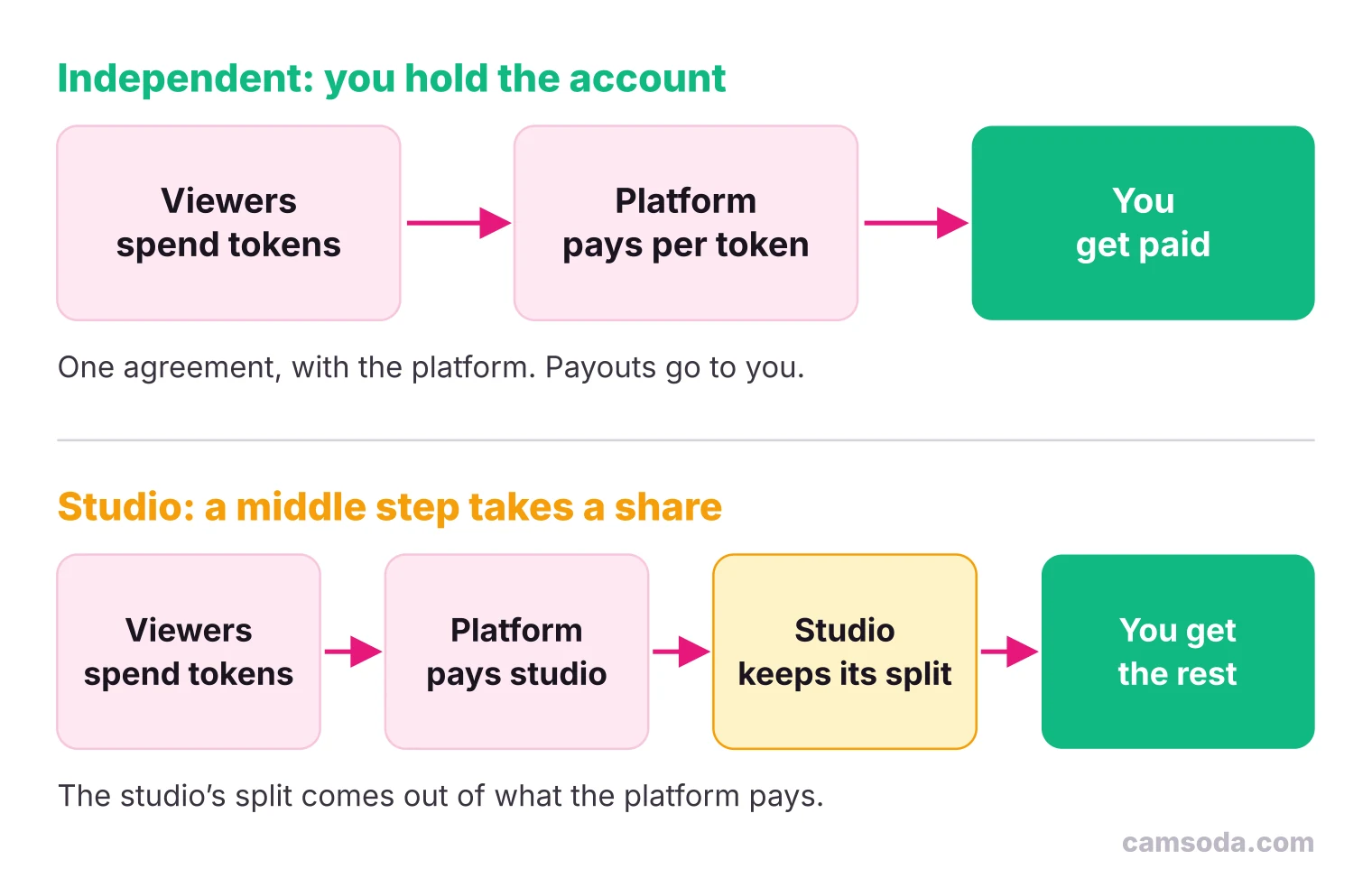
A studio’s split comes out of what the platform has already paid, so the same show earns you less through a studio than on your own account. In return, a good studio can provide a room, equipment, training and support. Studios publish very different terms: Studio 20’s recruiting page, for example, states a 50% gross commission for its models, rising to as much as 65% with bonuses tied to hours online, income and tenure (Studio 20’s own page, checked October 2026). Human Rights Watch’s December 2024 report on Colombian webcam studios found that the studios its interviewees worked in kept between 35% and 70% of what the platforms paid out (Human Rights Watch; its sample is not representative of all studios).
To see what a split means, take an illustrative example: 1,000 tokens received on CamSoda at the stated $0.05 per token is $50. On your own account, the $50 is yours, before taxes. If a studio held the account and kept half, you would receive $25.
| Independent (your own account, e.g. CamSoda) | Studio or agency job | |
|---|---|---|
| Who holds the account | You | Often the studio |
| Who the platform pays | You, on the platform’s schedule | The studio, which pays you its agreed share |
| Your share | The platform’s published model rate | The platform rate minus the studio’s split |
| Where you work | Home or any private space you set up | The studio’s rooms, or home under its management |
| Equipment and training | Yours to buy and learn | Often provided |
| Hours | You decide | Often set shifts or minimum hours |
| Contract | The platform’s performer agreement and terms | The studio’s contract, plus the platform’s terms |
| If you leave | Your account and audience stay yours | Depends on the contract; ask before you sign |
A studio can make sense if you have no private space or equipment, or want hands-on training. If you have a quiet room, a decent camera and a reliable connection, applying directly keeps the full model rate and your account in your name.
How to tell a legitimate recruiting ad from a predatory one
Most recruiters are ordinary businesses, but the industry also attracts offers built to take money or control from new models. The same few questions sort them quickly.
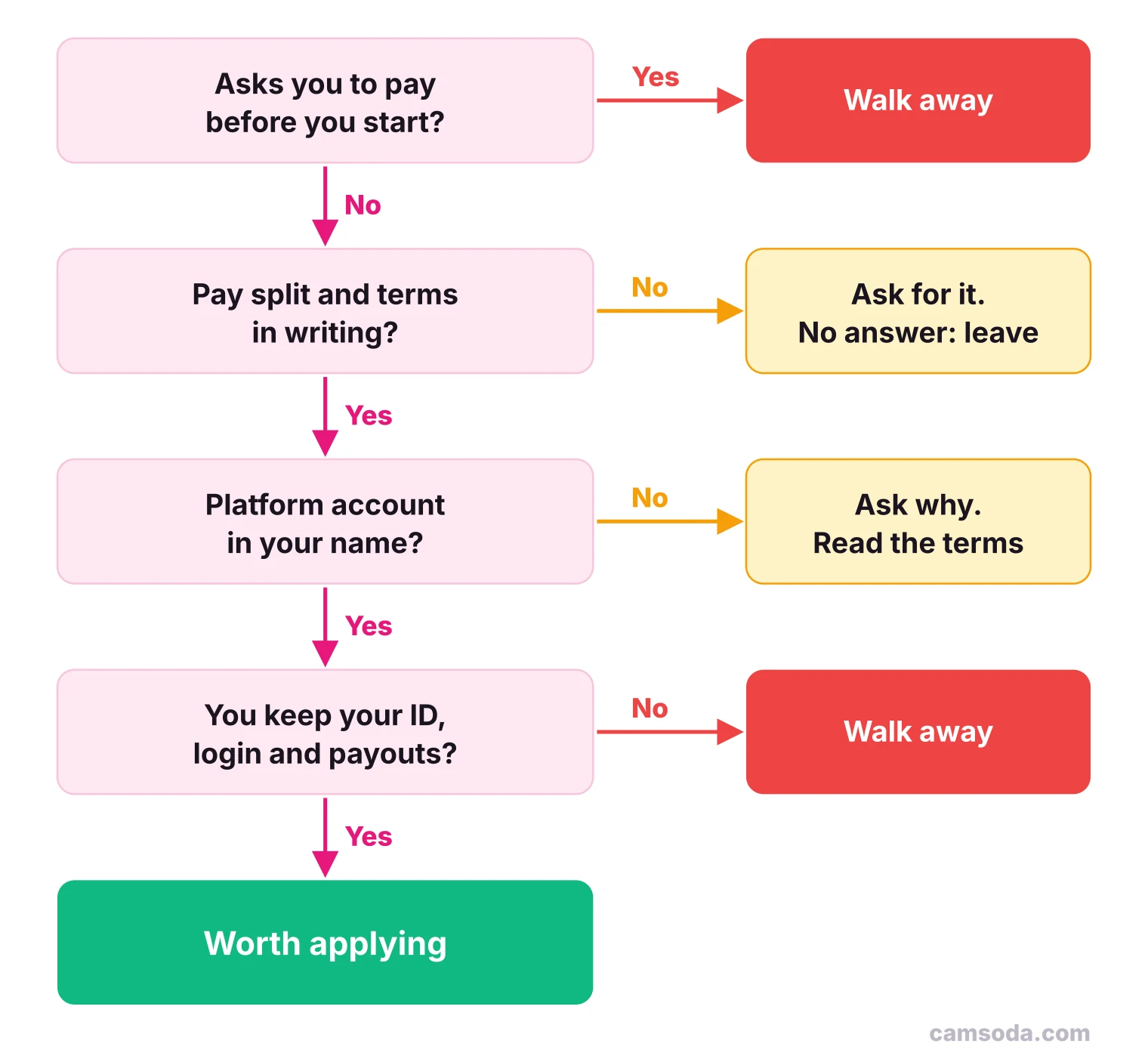
Signs of a legitimate offer
- It names the platforms you would stream on, and you can check those platforms’ own model pages.
- It states the split or pay terms in writing, and you get a copy of the contract before you start.
- It requires age and identity verification, done by the platform, with your own documents.
- The account on each platform is in your name, and you can see your own earnings.
- It answers questions about what happens to your account and pending pay if you leave.
Red flags in webcam modeling job ads
- A fee to start. Paying for training, a “starter kit”, equipment or a spot on the roster before you earn anything. The FTC’s guidance on job scams is plain: don’t pay for the promise of a job, and walk away from a placement fee you have to pay in advance.
- “Earn up to” headlines with no terms. A big monthly or weekly figure, with no split, no platform names and no contract on offer.
- No written contract, or no copy for you. Human Rights Watch found that 31 of the 50 studio models who answered had not signed a written contract when they started, and 49 of 50 had never seen the terms of service of the platforms they streamed on.
- Someone else holds your account, your ID or your login. The same report describes studios that did not let models take their accounts with them when they left.
- Pay through the recruiter only. No way to see what the platform paid, or deductions for fines, loans or exchange rates you never agreed to.
- Pressure. Being rushed to sign, to start that day or to stream longer than you agreed.
Before you reply to any ad, search the studio’s or recruiter’s name with “review” and “scam”, and ask the platform it names whether it works with that studio. If you paid a recruiter and suspect fraud, report it at ReportFraud.ftc.gov, as the FTC advises. If anyone holds your ID, controls your money or pressures you to perform, stop and get help: in the U.S., the National Human Trafficking Hotline takes calls at 1-888-373-7888.
Applying directly to a platform: CamSoda as an example
Applying directly is the option job boards don’t list. There is no recruiter in between: you register as a model, verify your identity and wait for the platform to review your application. CamSoda’s published process looks like this:
- Register through the Model Signup flow with a username, password and email. The username is permanent, so choose your stage name first.
- Accept the Terms & Conditions.
- Review and electronically sign the Independent Performer Agreement.
- Verify your identity and age with an image of a government-issued ID and a current selfie.
- Add your payout information and submit. U.S. residents also provide tax details.
CamSoda’s Help Center says applications are typically reviewed within 48 hours; that is an estimate, not a guaranteed approval time. Our step-by-step guide on how to become a cam model covers what to prepare before you apply, from your room to your first broadcast.
Once you are approved, the payout terms are published rather than negotiated. On CamSoda, pay periods run Monday through Sunday, ending at 23:59 UTC, and payments are typically issued by the following Thursday. The minimum payout is $20 for standard methods, or $500 for international wire transfers, and earnings below your minimum roll over to the next period. Listed payout methods are check (U.S. and Canada), direct deposit (U.S. only), domestic or international wire, and Paxum for international models. CamSoda says it does not currently pay models in cryptocurrency. The details are on CamSoda’s model payouts page.
Compare that with any recruiting ad: you can read every term before you start, the account is yours and the platform pays you directly.
Contractor, not employee: what that changes
Because cam platforms work with models as independent performers, a cam modeling job comes without the things an employer usually provides:
- No hourly wage. You earn from tokens. Quiet hours earn little; a regular audience is what makes the work steady.
- Your own taxes. Nobody withholds tax for you. CamSoda asks U.S. residents for tax details at signup; set money aside for taxes from each payout and keep records of your earnings and costs.
- Your own equipment and space. A camera, lighting, a stable connection and a private room are your investment, not the platform’s.
- Your own schedule and rules. You decide when you stream, what your room offers and what you won’t do. No platform or studio can require more than your agreement says.
Earning well as a contractor comes down to how you run your shows: schedules, tip menus, private shows and keeping regulars coming back. Our guide on how to make money camming covers those tactics.
Webcam model jobs FAQ
Is being a webcam model legal?
For adults working on established platforms, webcam modeling is legal in the United States and many other countries, but laws differ by country, so check the rules where you live. Every legitimate platform requires performers to be 18 or older and to verify their age and identity before they can earn.
What do you need to be a webcam model?
You need to be an adult with a government-issued photo ID, a private space, a camera, lighting and a reliable internet connection. On CamSoda, you also sign an Independent Performer Agreement, verify your identity with your ID and a current selfie, and add payout details; U.S. residents provide tax details.
How much do webcam models get paid?
There is no fixed salary: models earn from the tokens viewers spend. On CamSoda, one token is worth $0.05 to the model, a rate that may vary by region, and payouts are weekly once you reach the minimum. Our guide to how much cam models make covers the math in detail.
Do I have to pay to get a webcam modeling job?
No legitimate offer should ask you to pay before you earn. The FTC advises against paying for the promise of a job or an upfront placement fee. Treat any charge for training, a starter kit or a place on a roster as a reason to walk away.
What is the highest paying cam site?
No single site pays the most for everyone: earnings depend on the audience you build, your hours and the site’s rate per token. Compare sites on the model rate they publish, the minimum payout and the payout schedule. CamSoda publishes its rate of $0.05 per token to the model and a $20 minimum payout for standard methods.
Is it better to join a studio or work independently?
A studio can supply a room, equipment and training, but it keeps a share of what the platform pays. Working independently, you hold your own account and receive the platform’s full model rate. If you choose a studio, get the split in writing and make sure the account is in your name. When you are ready to apply directly, start from CamSoda’s model page.