






Guides
Camming Industry Statistics: Size, Hubs, Money Split and Rules
The camming industry in sourced numbers: how big it is, where studios cluster, who keeps what from each $100 spent, and the rules regulators now apply.

The camming industry is the business of live adult webcam shows paid for with tokens, tips and per-minute private sessions. Human Rights Watch describes it as a billion-dollar global industry, but no audited total exists: the best figures come from academic studies, court records and reporting on the two countries where most studio models work, Romania and Colombia. This page collects those numbers by theme, each with its publisher, date and link.
This is CamSoda’s blog, and CamSoda is one of the platforms in this market. Its own numbers appear below only where they come from its published help pages. For the wider picture of the work itself, start with our guide to cam modeling.
Camming industry statistics at a glance
| Figure | What it measures | Source and date |
|---|---|---|
| $0.05 | What one token is worth to a model on CamSoda | CamSoda model payouts page, checked October 2026 |
| 50 to 65% | Share of model-generated income kept by platforms | Academic studies from 2014 and 2018, as cited by HRW, December 2024 |
| 22 of 50 | Most-visited cam platforms that turned out to be white-label copies of others | Stegeman et al., Sexualities, 2023, as cited by HRW |
| 35 to 70% | Cut of platform payouts kept by Colombian studios, per models interviewed | HRW, December 2024 |
| About 40,000 | Webcam models in Colombia (industry estimate) | El Tiempo, May 2020 |
| Up to US$40 million | Yearly revenue of Colombia’s webcam sector | Forbes Colombia, May 2021 |
| About 500 | Estimated cam studios in Romania | AFP, February 2023 |
| 45 million | Monthly EU users that make a platform “very large” under the Digital Services Act | EU General Court, October 2026 |
Every figure is explained, with its link, in the sections below. Where sources disagree, we say so rather than pick one.
How big is the camming industry?
Nobody publishes a verified global revenue figure for the camming business. The most careful recent source, Human Rights Watch’s December 9, 2024 report on Colombian webcam studios, calls it “a billion-dollar global industry” and then explains why a precise size is hard to pin down. Angela Jones’s book Camming (NYU Press, February 2020) describes it as a business worth multiple billions of dollars. Neither gives an audited total, and any page that quotes an exact global number to the dollar is quoting an estimate.
Three things blur the count:
- White-label sites. Many cam sites are skins on top of a larger platform and show the same performers. A 2023 study by Stegeman and colleagues in Sexualities, as summarized by HRW, found that 22 of the 50 most-visited webcam platforms were white-labels. The market looks more crowded than it is.
- Traffic from porn sites. Large adult video sites embed live cams, and researchers usually leave those sites out. The same 2023 study started from 228 platforms and kept 50 whose main interface was camming, HRW reports.
- Self-reported numbers. Country figures mostly come from studio owners and industry groups, who have reasons to round up.
Single-platform numbers give a sense of scale. A 2020 study by Olav Velthuis and Niels van Doorn, cited by HRW, counted over 50 million registered members and 1.5 million registered performers on LiveJasmin, of whom over 400,000 were active. Regulators have counted audiences too, as the EU section below shows.
Where the camming industry is concentrated
Independent models stream from home all over the world. Studio-based camming, where models work shifts in a rented room with the studio’s equipment, is concentrated in a few lower-income countries. A 2018 article by van Doorn and Velthuis in the Journal of Cultural Economy, quoted by HRW, names Romania, Colombia and the Philippines as central hubs.
Colombia
- About 40,000 Colombian webcam models and about 6,000 studios, nearly half of them in Medellín, according to local industry estimates reported by El Tiempo on May 2, 2020. The same article cites industry figures putting Colombian models at about 30% of the world’s webcam models, second only to Romania.
- Up to US$40 million a year in revenue, at least 15,000 indirect jobs and up to 50,000 direct modeling jobs, according to Forbes Colombia on May 10, 2021. Preliminary figures cited there count more than 500 legally registered companies.
- “More than 5,000 studios,” estimated by a studio owner interviewed by El País in May 2022, who added that many operate underground.
Romania
- An estimated 500 studios, according to an AFP report published on February 14, 2023 (as carried by Raw Story). The same report says clients pay between $2 and $10 per minute for private conversations.
- In that report, a manager at one large studio said it had 160 women on its books and that their average monthly after-tax pay was $8,000. That is one studio’s claim about its own models, not an industry average.
- A representative of a models’ group told AFP that Romanian women account for 40% of the videochat industry worldwide. VICE’s June 2018 documentary called Bucharest “the camming capital of the world” without giving a figure.
Why the country figures do not add up
Colombia’s studio count runs from more than 500 registered companies (Forbes Colombia) to about 6,000 (El Tiempo) and more than 5,000 (El País). The share claims do not fit together well either: 30% of models from Colombia and 40% of the industry from Romania would leave 30% for the rest of the world, including every independent model in the US and Europe. Each of these is an industry estimate, not a census. Treat them as signs of where studios cluster, not as measurements.
How the camming business makes money
Viewers buy tokens from the platform and spend them on tips, interactive toy features and private shows. Our explainer on what camming is walks through the show types. The platform pays the model a fixed value per token and keeps the difference.
- Per-token value. CamSoda’s model payouts page states that one token is worth $0.05 to models, and notes that this may vary by region. HRW reports the same $0.05 rate for Chaturbate and Stripchat, from their own guides and FAQs.
- What the viewer paid for that token. CamSoda’s token packages run from $6.99 for 50 tokens to $249.99 for 3,100 at the listed US prices, about 14 cents a token on the smallest package and about 8 cents on the largest. Prices vary by country and are confirmed at checkout.
- Platform share across the industry. Academic studies from 2014 (Bleakley, Sexuality & Culture) and 2018 (van Doorn and Velthuis), as cited by HRW, found that platforms retain between 50 and 65% of the income models generate.
- Pay cycle. On CamSoda, pay periods run Monday to Sunday, payments are typically issued by the following Thursday, and the minimum payout is $20 for standard methods.
What a model takes home from all this is a different question, with different numbers. Our guide to how much cam models make covers earnings surveys and token-to-dollar math.
Studio or independent: where $100 of viewer spending goes
The biggest split in the webcam modeling industry is between models who stream on their own account and models who stream from a studio. A studio supplies the room, computer, camera and internet, and keeps a cut of what the platform pays out. HRW’s interviews found that Colombian studios keep between 35 and 70% of platform payouts, which, the report says, can leave a model with as little as 10% of what their performance earned.
Here is the arithmetic on $100 spent by viewers, using only those published ranges. These are illustrative numbers, not any one site’s rates:
- Independent model, platform keeps 50%: the platform keeps $50, the model receives $50.
- Studio model, best case (platform 50%, studio 35%): the platform keeps $50, the studio takes $17.50 of the remaining $50, the model receives $32.50.
- Studio model, worst case (platform 65%, studio 70%): the platform keeps $65, the studio takes $24.50 of the remaining $35, the model receives $10.50.
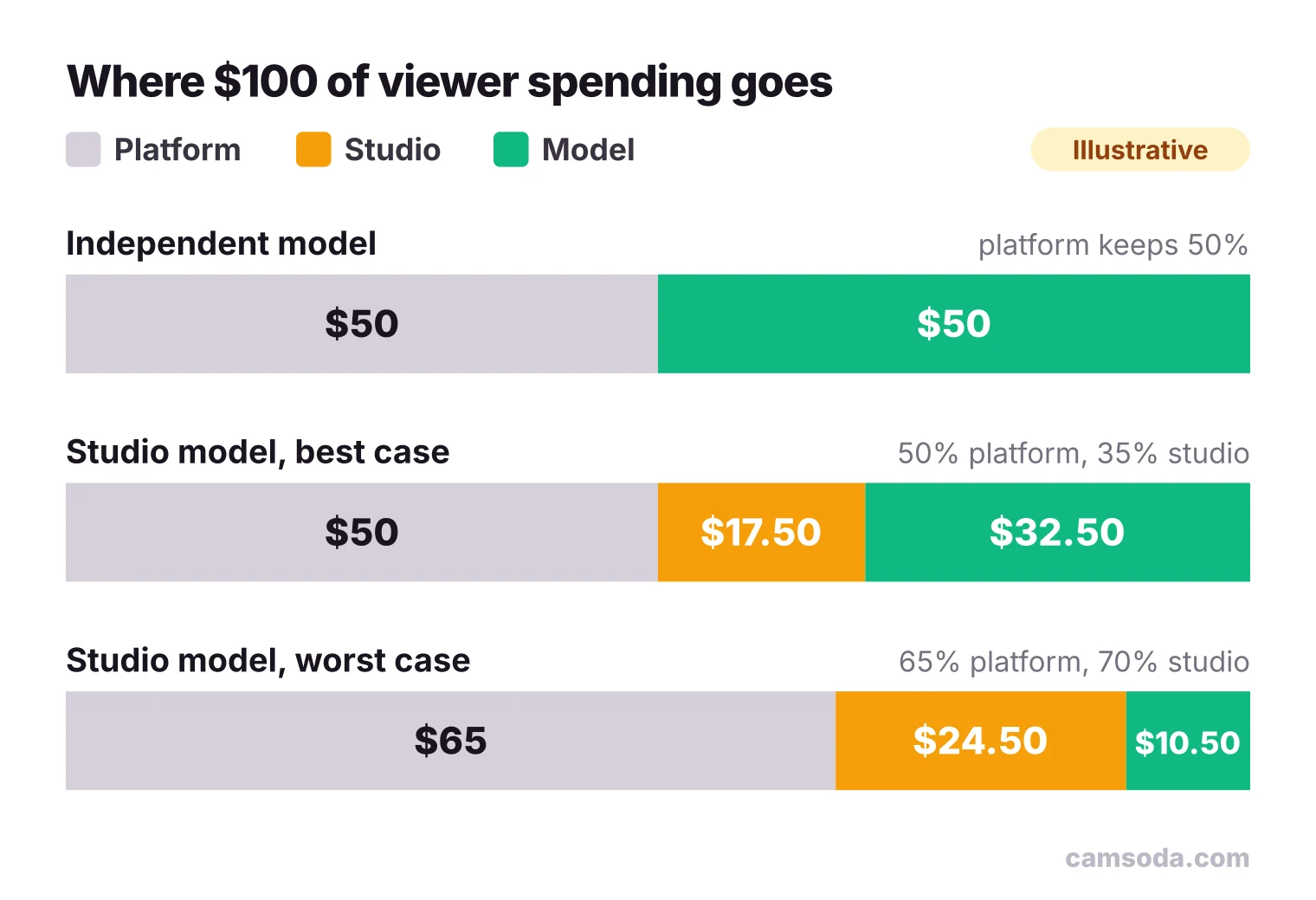
A studio is not always the wrong choice: HRW notes that studios open the work to people without a private room, equipment or reliable internet at home. But the gap between $50 and $10.50 is why the contract matters. Our guide to webcam model agencies lists the terms to check before you sign, and the one on webcam model jobs explains how to tell a fair recruiting ad from a predatory one.
Working conditions: what research found
The fullest recent data on working conditions comes from HRW, which spent 18 months on its investigation with two sex worker-led organizations, in Bogotá, Cali, Medellín and Palmira, and interviewed 55 webcam models. Among the 50 who answered its survey questions:
- 49 of 50 said they had never seen or signed the terms of service of any platform they streamed on; most said the studio opened the account for them.
- 31 of 50 said they had no written contract with their studio. Of the 19 who signed one, only 10 received a copy.
- 32 of 50 were recruited through a personal contact and 10 through social media ads.
The report also describes shifts of up to 18 hours without a break. On the other side of the ledger, it notes that camming has given income to people with limited access to other work, including people with disabilities, single parents and queer people.
Individual accounts point the same way. A former model told Marie Claire UK in March 2022 that her first agency took a very high share of her earnings and sometimes did not pay at all, and that she received threats when she left to work independently. In Romania, AFP reported in 2023 that the industry is legal but neither regulated under Romanian law nor recognized for tax purposes, and that a studio manager and an industry event organizer said they would welcome regulation.
Demand rose during the pandemic. El Tiempo reported in May 2020 that Colombian business owners saw demand rise about 30%, and Forbes Colombia reported in May 2021 that the sector’s income rose 30% during the pandemic. Neither is an audited figure.
Rules that now shape the industry
Regulators now measure cam platforms and set rules for them. Two decisions carry numbers.
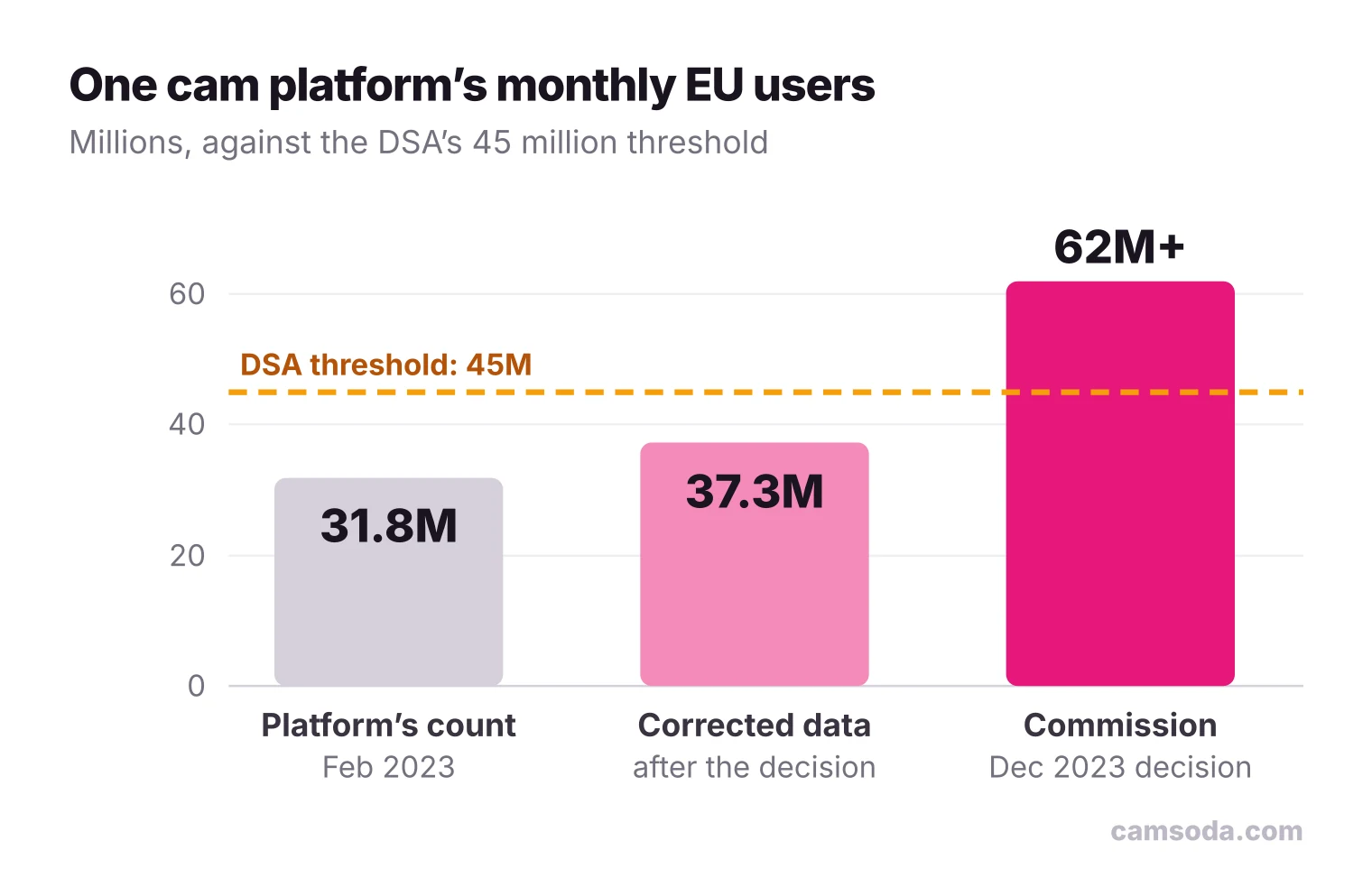
The EU’s Digital Services Act. The DSA puts stricter transparency, risk-management and oversight duties on platforms with more than 45 million monthly users in the EU. According to the EU General Court’s press release of October 14, 2026 (case T-134/24), Stripchat’s operator reported about 31.8 million average monthly active recipients in February 2023. The European Commission counted more than 62 million monthly unique visitors and designated the platform a very large online platform on December 20, 2023. The court upheld that designation, even though corrected data later put the figure at about 37.3 million.
US age verification. In Free Speech Coalition v. Paxton, decided June 27, 2025 by a 6 to 3 vote, the Supreme Court upheld a Texas law that requires commercial websites to verify that visitors are 18 or older when more than one-third of what they publish is sexual material harmful to minors. Rules for viewers now differ by state and country, which our guide on whether cam sites are legal covers in detail.
On the performer side, age and identity checks are standard. CamSoda’s model application requires an image of a government-issued ID and a current selfie, and all performers must be adults.
Research on the webcam modeling industry
If you want to go past the headline numbers, these are the main academic sources:
- Angela Jones, Camming: Money, Power, and Pleasure in the Sex Work Industry (NYU Press, 2020): the first book-length study, built on interviews, survey data and web analytics.
- Niels van Doorn and Olav Velthuis, “A good hustle” (Journal of Cultural Economy, 2018): how competition between models works on platforms.
- Hanne M. Stegeman and colleagues, “Hypercategorization and hypersexualization” (Sexualities, 2023): how platforms organize performers, and the white-label count.
- Hannah DeLacey, “Adult webcam industry” dataset (DANS, 2023): 32 interviews, 24 of them with webcam models (22 in the United States), on regulation, mental health, consent and stigma. The record is metadata only; the interviews are not open for reuse.
What the numbers mean if you are thinking about camming
Read together, the statistics say three things. Platforms keep a large share of every token, so the per-token value is the first number to check. Studio work can cut what you keep to a fraction of what you earn, so the split and the contract matter more than any headline income. And the most-quoted size figures are estimates, so ignore recruiters who promise a share of a “billion-dollar” market.
If you have the room and equipment to stream on your own, applying directly to a platform keeps the studio out of the split. Our step-by-step guide on how to become a cam model covers the setup, ID checks and first payout. When you are ready, CamSoda’s model signup starts the application.
Camming industry FAQ
How big is the camming industry?
Human Rights Watch described adult webcamming as a billion-dollar global industry in its December 2024 report. No audited global total exists, because white-label sites, cams embedded on porn sites and self-reported industry figures all blur the count.
Which country has the most cam models?
Industry sources point to Romania first and Colombia second. El Tiempo reported in 2020 that Colombia ranks second behind Romania and has about 40,000 webcam models, but these are industry estimates, not official counts.
How much of a tip does a cam model keep?
Academic studies cited by Human Rights Watch found that platforms keep 50 to 65% of what models generate. A model working from a Colombian studio may lose another 35 to 70% of the payout to the studio, according to HRW’s interviews. On CamSoda, a token is worth $0.05 to the model.
Is camming a legitimate business?
Camming is a legal business for verified adults in many countries, run by registered platforms that check performers’ age and identity. Laws differ by country and US state, and HRW documented serious labor abuses in some Colombian studios, so who you work with matters as much as where.
Is the camming industry growing?
There is no audited time series. Colombian outlets reported that demand rose about 30% during the 2020 pandemic (El Tiempo) and that sector income rose 30% (Forbes Colombia), both from industry sources.